ERP Software for Inventory Management: The Backbone of Modern Supply Chains
In the intricate dance of modern commerce, inventory management stands as a critical choreography, dictating efficiency, profitability, and customer satisfaction. From raw materials awaiting transformation to finished goods poised for market, every item in a company’s inventory represents a significant investment and a potential revenue stream. Mismanaged inventory, however, can quickly turn into a financial burden, leading to crippling costs from overstocking, lost sales from stockouts, and operational inefficiencies that cripple a business.
Enter Enterprise Resource Planning (ERP) software – a comprehensive, integrated suite of business management tools that has emerged as the quintessential solution for navigating the complexities of modern inventory. Far more than just a stock-tracking system, an ERP for inventory management acts as the central nervous system of a company’s supply chain, providing real-time visibility, automation, and intelligent insights that transform chaotic warehouses into streamlined hubs of productivity. This article will delve into the profound impact of ERP software on inventory management, exploring its core functionalities, unparalleled benefits, crucial implementation considerations, and the future trends shaping its evolution.
The Criticality of Effective Inventory Management
Before exploring the ERP solution, it’s essential to understand the inherent challenges and paramount importance of inventory management. Businesses grapple with numerous issues:
- Balancing Act: The perpetual struggle between having enough stock to meet demand (avoiding lost sales and customer dissatisfaction) and not having too much (avoiding high carrying costs, obsolescence, and spoilage).
- Data Silos: Disconnected systems for sales, purchasing, production, and warehousing lead to inaccurate data, manual errors, and a lack of holistic visibility.
- Forecasting Inaccuracies: Without robust data and analytical tools, predicting future demand is often guesswork, leading to either stockouts or excess inventory.
- Operational Inefficiencies: Manual processes for tracking, picking, packing, and shipping are time-consuming, error-prone, and costly.
- Lack of Traceability: In industries with strict regulations (e.g., food, pharmaceuticals), tracking batches and serial numbers for recalls or compliance can be a nightmare.
- Cost Implications: Inventory costs encompass not just the purchase price but also storage, insurance, security, obsolescence, and the opportunity cost of capital tied up in stock.
Effective inventory management directly impacts a company’s bottom line, operational efficiency, and reputation. It’s about ensuring the right product is in the right place at the right time, at the lowest possible cost.
What is ERP Software? A Unified Approach
At its core, ERP software is an integrated system designed to manage all facets of an enterprise’s operations, from finance and human resources to manufacturing, supply chain, and customer relationship management. Unlike standalone applications that operate in isolation, an ERP system consolidates data from various departments into a single, centralized database. This "single source of truth" eliminates data redundancy, improves accuracy, and provides a comprehensive, real-time view of business operations.
For inventory management, this integration is transformative. Instead of disparate spreadsheets or legacy systems, all inventory-related data – including sales orders, purchase orders, production schedules, shipping information, and financial records – resides within one cohesive platform. This interconnectedness allows for seamless information flow, enabling departments to work in sync and make data-driven decisions.
How ERP Transforms Inventory Management: A Deeper Dive
The power of ERP in inventory management stems from its ability to provide comprehensive oversight and automation across the entire supply chain. Let’s explore its key transformative aspects:
1. Real-time Visibility and Data Accuracy
Perhaps the most significant benefit of an ERP system is the provision of real-time, accurate inventory data.
- Centralized Database: All inventory information, regardless of its source (sales, purchasing, warehousing), is stored in one place. This eliminates data duplication and discrepancies that plague siloed systems.
- Automated Tracking: As items move through the supply chain – from inbound shipments to warehouse transfers and outbound deliveries – the ERP system automatically updates stock levels. This can be integrated with barcode scanners, RFID technology, and other automated data capture methods, drastically reducing manual errors.
- Comprehensive Stock Overview: Managers can instantly see current stock levels, goods in transit, allocated stock, reorder points, and even historical movement for any item across all locations. This unparalleled visibility empowers informed decision-making.
2. Optimized Stock Levels and Demand Forecasting
One of the greatest challenges in inventory is balancing supply with demand. ERP systems leverage advanced analytics to tackle this:
- Sophisticated Forecasting: ERP modules can analyze historical sales data, seasonal trends, promotional impacts, market fluctuations, and even external factors to generate highly accurate demand forecasts. This moves businesses beyond guesswork.
- Automated Reorder Points & Safety Stock: Based on lead times, demand forecasts, and desired service levels, the ERP can automatically calculate and suggest optimal reorder points and safety stock levels, triggering purchase orders when stock dips below predefined thresholds.
- Minimizing Overstocking and Stockouts: By accurately predicting demand and automating reordering, businesses can significantly reduce carrying costs associated with excess inventory while simultaneously preventing stockouts that lead to lost sales and customer dissatisfaction.
3. Enhanced Warehouse Management (WMS Integration)
Many ERP systems include or integrate seamlessly with robust Warehouse Management Systems (WMS) functionalities, optimizing every aspect of warehouse operations:
- Intelligent Storage Location: The system can guide staff to optimal storage locations based on product type, size, velocity, and expiry dates, improving space utilization.
- Optimized Picking Paths: ERP can generate efficient picking routes for warehouse personnel, minimizing travel time and accelerating order fulfillment.
- Batch and Serial Number Tracking: Essential for traceability, quality control, and compliance in regulated industries, ERP tracks items by lot, batch, or serial number from receipt to shipment.
- Cycle Counting and Physical Inventory: ERP streamlines these processes by providing tools for efficient counting, discrepancy reporting, and reconciliation, reducing the need for disruptive full physical inventories.
- Cross-Docking & Kitting: Facilitates advanced warehouse strategies like cross-docking (moving goods directly from inbound to outbound) and kitting (assembling components into ready-to-ship kits).
4. Streamlined Procurement and Supplier Management
Inventory starts with procurement. ERP systems integrate inventory needs directly with purchasing:
- Automated Purchase Order Generation: Based on inventory levels, forecasts, and sales orders, the ERP can automatically generate purchase requisitions and orders, ensuring timely replenishment.
- Supplier Performance Tracking: Businesses can monitor supplier lead times, delivery accuracy, quality, and pricing directly within the ERP, fostering better supplier relationships and negotiation leverage.
- Invoice Matching: Automates the matching of purchase orders, goods receipts, and supplier invoices, reducing errors and speeding up payment processes.
5. Improved Order Fulfillment and Customer Satisfaction
Efficient inventory management directly translates to happier customers:
- Faster Order Processing: Real-time stock visibility and automated picking/packing accelerate the order-to-delivery cycle.
- Accurate Order Status: Sales teams and customers can access real-time information on product availability and order shipping status.
- Reduced Backorders: By preventing stockouts and improving replenishment, ERP minimizes backorders and ensures customers receive their goods on time.
- Optimized Shipping: Integration with shipping carriers allows for automated label generation, tracking, and optimized freight selection.
6. Cost Reduction and Profitability Enhancement
The financial benefits of ERP-driven inventory management are substantial:
- Lower Carrying Costs: Reduced excess inventory means lower storage costs, insurance, and reduced risk of obsolescence.
- Minimized Stockout Costs: Fewer lost sales, reduced expedited shipping fees, and maintained customer loyalty.
- Reduced Operational Costs: Automation minimizes manual labor, administrative overhead, and errors.
- Better Cash Flow: Capital is not tied up in slow-moving or obsolete inventory, improving liquidity.
- Improved Negotiation Power: Accurate data on demand and supplier performance strengthens purchasing negotiations.
7. Compliance and Traceability
For many industries, strict regulatory compliance is non-negotiable. ERP systems provide the necessary tools:
- End-to-End Traceability: From raw material to finished product, ERP tracks every movement, batch, and serial number, crucial for audits, quality control, and product recalls.
- Regulatory Reporting: Simplifies the generation of reports required by regulatory bodies (e.g., FDA, health and safety standards).
Key Features of ERP for Inventory Management
While the transformative aspects describe how ERP helps, specific features enable these benefits:
- Inventory Tracking & Categorization: Detailed records for each item, including SKUs, descriptions, units of measure, weight, dimensions, and categorization (e.g., raw material, work-in-progress, finished goods).
- Multi-location/Multi-warehouse Support: Manage inventory across multiple warehouses, distribution centers, and retail stores from a single interface.
- Demand Planning & Forecasting Tools: Algorithms for predicting future demand based on historical data, seasonality, and other variables.
- Reorder Point Management: Automated calculation and notification for optimal reorder levels and quantities.
- Lot/Batch & Serial Number Tracking: For precise traceability and recall management.
- Cycle Counting & Physical Inventory Management: Tools to streamline inventory counting processes, identify discrepancies, and reconcile stock.
- Warehouse Layout & Bin Location Management: Optimizing storage and retrieval.
- Kitting & Assembly: Managing the process of combining multiple components into a single sellable unit.
- Returns Management (RMA): Streamlining the process of handling customer returns, including inspection, restocking, or repair.
- Reporting & Analytics: Customizable dashboards and reports providing insights into inventory turnover, carrying costs, stock levels, aging inventory, and supplier performance.
- Integration with Other Modules: Seamless links with Sales (order management), Purchasing (procurement), Production (BOMs, WIP), Finance (costing, valuation), and CRM.
Benefits of Implementing ERP for Inventory Management
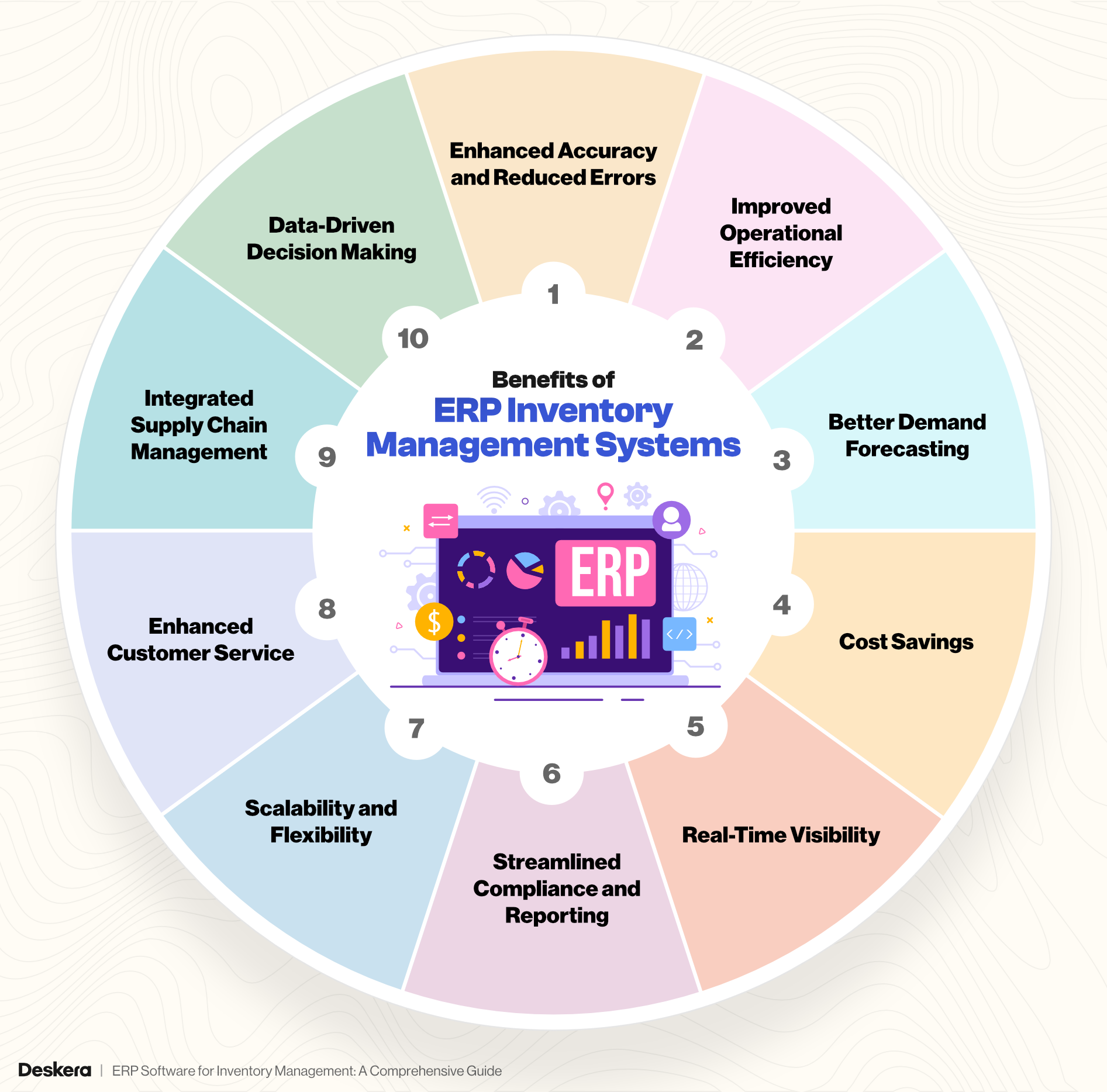
In summary, the implementation of ERP software for inventory management delivers a cascade of benefits:
- Increased Efficiency & Automation: Reduces manual tasks, errors, and operational bottlenecks.
- Reduced Costs: Lowers carrying costs, stockout costs, and operational expenditures.
- Enhanced Accuracy & Visibility: Provides real-time, precise data across the entire inventory lifecycle.
- Improved Customer Satisfaction: Faster fulfillment, fewer backorders, and accurate delivery information.
- Better Decision-Making: Data-driven insights for strategic planning, purchasing, and sales.
- Scalability: Supports business growth by efficiently managing increasing inventory volumes and complexities.
- Competitive Advantage: Streamlined operations and superior service foster a stronger market position.
Challenges and Considerations for Implementation
While the benefits are compelling, implementing an ERP system for inventory management is a significant undertaking that comes with its own set of challenges:
- High Initial Cost: ERP systems, especially comprehensive ones, require substantial investment in software licenses, hardware, implementation services, and customization.
- Complexity and Customization: Tailoring the ERP to specific business processes can be complex and time-consuming. Over-customization can lead to higher costs and difficulties with upgrades.
- Data Migration: Transferring existing inventory data from old systems to the new ERP can be a monumental task, requiring meticulous planning and execution to ensure data integrity.
- User Adoption and Training: Employees must be trained to use the new system effectively. Resistance to change can hinder adoption and negate potential benefits.
- Change Management: Implementing an ERP fundamentally alters business processes, requiring strong leadership and a clear communication strategy to manage organizational change.
- Vendor Selection: Choosing the right ERP vendor and solution (on-premise vs. cloud, industry-specific vs. generic) is crucial and requires thorough research and due diligence.
The Future of ERP in Inventory Management
The landscape of inventory management is continuously evolving, and ERP systems are at the forefront of this innovation:
- Artificial Intelligence (AI) and Machine Learning (ML): AI/ML will further enhance predictive analytics for demand forecasting, optimize inventory placement, and even automate replenishment decisions with greater precision.
- Internet of Things (IoT): IoT devices (e.g., smart shelves, GPS trackers) will provide even more granular, real-time data on inventory location, environmental conditions, and movement, feeding directly into the ERP.
- Blockchain Technology: For ultimate supply chain transparency and traceability, blockchain could be integrated to create immutable records of inventory movement and ownership.
- Cloud-Based ERP: The shift towards cloud-based ERP solutions continues, offering greater flexibility, scalability, lower upfront costs, and easier access from anywhere.
- Robotics and Automation: Integration with robotic process automation (RPA) and autonomous mobile robots (AMRs) in warehouses will further automate picking, packing, and inventory movement.
Conclusion
In today’s fast-paced global economy, efficient inventory management is not merely an operational necessity but a strategic imperative. ERP software stands as the most powerful tool available to businesses seeking to master this complex domain. By integrating data, automating processes, and providing unparalleled real-time visibility and analytical capabilities, ERP transforms inventory from a potential liability into a significant competitive advantage.
While the journey to implement an ERP system can be challenging, the long-term rewards – reduced costs, increased efficiency, enhanced customer satisfaction, and improved profitability – make it an indispensable investment for any modern enterprise aiming to thrive in the dynamic landscape of the global supply chain. As technology continues to advance, the role of ERP in orchestrating the perfect inventory dance will only grow stronger, ensuring businesses are always ready for the next step.
Leave a Reply