Navigating the Digital Core: A Deep Dive into the World’s Top ERP Vendors
In today’s hyper-competitive global landscape, businesses are constantly seeking ways to optimize operations, enhance efficiency, and gain a decisive edge. At the heart of this pursuit lies Enterprise Resource Planning (ERP) – a robust system designed to integrate and manage core business processes across an organization. From finance and human resources to supply chain and manufacturing, ERP systems provide a unified platform for data, fostering collaboration, streamlining workflows, and empowering informed decision-making.
However, the journey to digital transformation via ERP is often complex, fraught with choices that can profoundly impact a company’s future. The market is populated by a diverse array of vendors, each offering unique strengths, functionalities, and deployment models. Choosing the right ERP vendor is not merely a technological decision; it’s a strategic investment that requires careful consideration of a company’s size, industry, specific needs, budget, and long-term vision.
This comprehensive article delves into the world of top ERP vendors, exploring their offerings, target markets, and key differentiators. We will also examine the critical factors businesses must consider when selecting an ERP system and highlight the emerging trends shaping the future of this vital technology.
What is ERP and Why is it Essential?
At its core, ERP software integrates various functions within an organization into a single, comprehensive system. Traditionally, departments like accounting, human resources, sales, and manufacturing might operate on disparate systems, leading to data silos, inefficiencies, and a lack of real-time visibility. ERP breaks down these barriers, creating a centralized database and a common user interface that allows information to flow seamlessly across the enterprise.
The benefits of a well-implemented ERP system are manifold:
- Improved Efficiency and Productivity: Automating routine tasks and standardizing processes reduces manual effort and accelerates operations.
- Enhanced Data Visibility and Analytics: A single source of truth provides real-time insights into business performance, enabling better strategic planning and operational adjustments.
- Streamlined Operations: Integration across departments minimizes redundancies and optimizes workflows, from order processing to inventory management.
- Better Decision-Making: Access to accurate, up-to-date information empowers managers to make data-driven decisions more quickly and confidently.
- Reduced Operational Costs: By optimizing resource utilization, minimizing waste, and improving process efficiency, ERP can lead to significant cost savings.
- Improved Customer Service: Faster order fulfillment, accurate inventory data, and better communication channels contribute to higher customer satisfaction.
- Regulatory Compliance and Risk Management: ERP systems often include features to ensure compliance with industry regulations and mitigate operational risks.
- Scalability and Adaptability: Modern ERP solutions are designed to grow with a business, adapting to changing market conditions and evolving business needs.
In essence, ERP acts as the central nervous system of a modern enterprise, orchestrating its various parts to function as a cohesive and agile unit.
Key Considerations When Choosing an ERP Vendor
Before exploring specific vendors, it’s crucial to understand the foundational criteria that should guide any ERP selection process. These considerations will help businesses narrow down their options and find a solution that truly aligns with their strategic objectives:
- Industry Fit and Specific Functionality: Different industries have unique operational requirements. A manufacturing company will need robust production planning and quality control modules, while a retail business might prioritize point-of-sale and e-commerce integration. Ensure the vendor has a proven track record and specialized solutions for your industry.
- Scalability: The chosen ERP system must be able to grow with your company. Can it handle increased transaction volumes, additional users, and new geographical locations without significant performance degradation or costly overhauls?
- Deployment Model:
- Cloud-based (SaaS): Hosted by the vendor, accessible via the internet. Offers lower upfront costs, easier maintenance, and scalability. Ideal for businesses seeking agility and reduced IT overhead.
- On-premise: Hosted and managed by the company on its own servers. Provides maximum control and customization but requires significant IT infrastructure and staff.
- Hybrid: A mix of both, combining the flexibility of cloud with the control of on-premise for specific applications or data.
- Total Cost of Ownership (TCO): Beyond initial licensing or subscription fees, consider implementation costs (consulting, customization, data migration), training, ongoing maintenance, support, and potential hardware upgrades. A seemingly cheaper upfront option might become more expensive over time.
- Integration Capabilities: An ERP system rarely operates in isolation. It must seamlessly integrate with existing or future systems like CRM, e-commerce platforms, IoT devices, and other specialized applications. Look for open APIs and a robust partner ecosystem.
- Customization vs. Configuration: Customization (modifying the core code) can be expensive and make future upgrades difficult. Configuration (adjusting settings within the system) is generally preferred as it maintains upgrade paths. Understand the vendor’s approach and how it balances flexibility with maintainability.
- User Experience (UX): An intuitive, easy-to-use interface is crucial for user adoption and productivity. A clunky or complex system can lead to resistance and underutilization.
- Vendor Reputation and Support: Research the vendor’s financial stability, market presence, customer support responsiveness, and continuous innovation. Look for strong community support and reliable service-level agreements (SLAs).
- Future-Proofing: Does the ERP system incorporate or have a roadmap for emerging technologies like Artificial Intelligence (AI), Machine Learning (ML), Robotic Process Automation (RPA), and IoT? This ensures the system remains relevant in the long term.
- Implementation and Training: A successful ERP implementation requires a clear strategy, experienced consultants, and comprehensive user training. Evaluate the vendor’s implementation methodology and partner network.
The Global Leaders: A Deep Dive into Top ERP Vendors
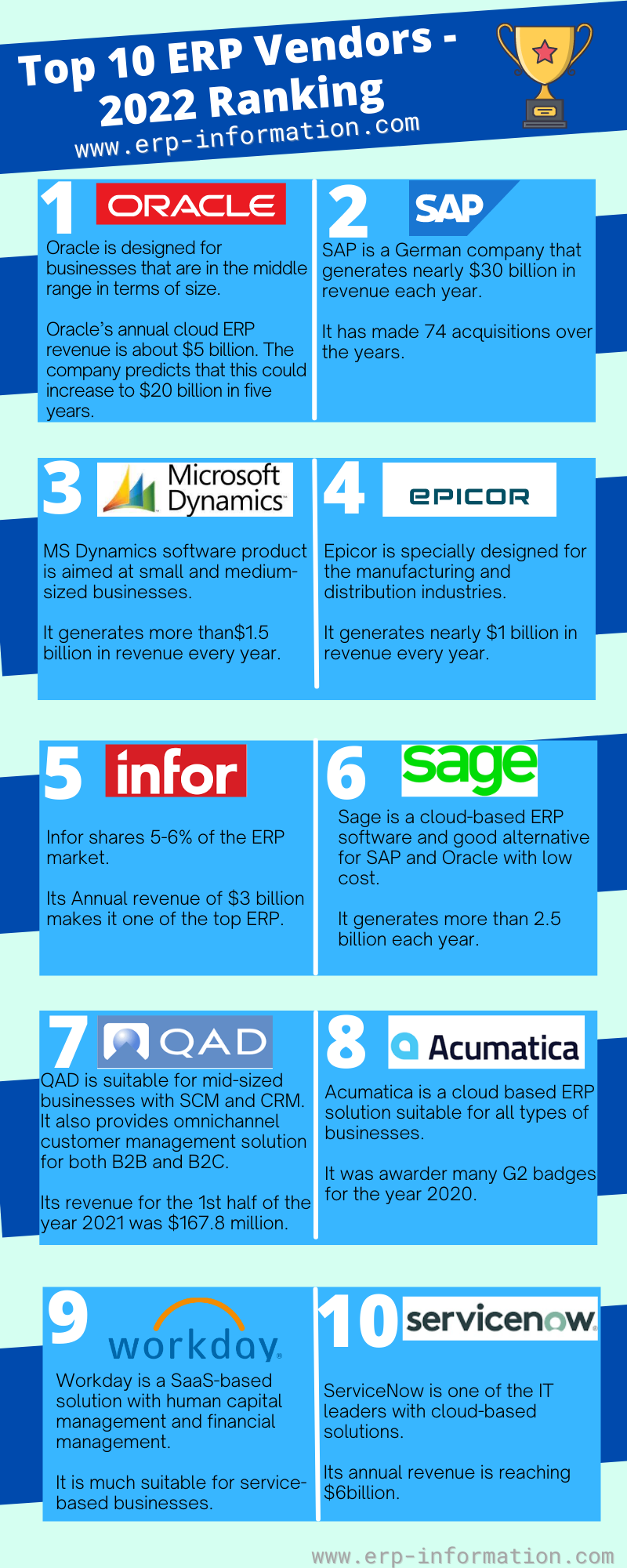
The ERP market is dominated by a few behemoths, alongside a vibrant ecosystem of specialized and emerging players. Here’s a look at some of the top ERP vendors globally:
1. SAP
- Overview: Headquartered in Germany, SAP (Systems, Applications & Products in Data Processing) is the undisputed market leader in ERP software, particularly for large enterprises. With over 400,000 customers in more than 180 countries, SAP solutions manage critical processes for a significant portion of the world’s largest companies.
- Key Products: Its flagship product is SAP S/4HANA, an intelligent, in-memory ERP suite designed for the digital economy. It offers advanced analytics, machine learning capabilities, and a simplified data model. SAP also offers industry-specific solutions and cloud-based ERP for mid-market (e.g., SAP Business ByDesign, SAP Business One).
- Strengths: Unparalleled breadth and depth of functionality, robust industry-specific solutions, strong global presence, extensive partner ecosystem, and continuous innovation in areas like AI and IoT.
- Target Market: Primarily large enterprises and multinational corporations across virtually all industries, but also offers solutions for mid-market and SMBs.
- Considerations: Can be complex and costly to implement and maintain, requiring specialized expertise. Customization can be challenging, and user experience has historically been a point of contention (though S/4HANA’s Fiori interface aims to address this).
2. Oracle
- Overview: The second-largest software company globally, Oracle offers a vast portfolio of enterprise software, including a powerful suite of ERP solutions. Known for its robust database technology, Oracle has aggressively transitioned to cloud-first offerings.
- Key Products: Oracle Fusion Cloud ERP is its flagship cloud-native suite, encompassing financials, project management, procurement, risk management, and more. Oracle also owns NetSuite, a leading cloud ERP solution primarily targeting mid-market businesses.
- Strengths: Comprehensive suite of integrated applications, strong financial management capabilities, powerful analytics, industry-leading database technology, and a rapid shift to cloud services. Its vast ecosystem includes HR, CRM, SCM, and EPM.
- Target Market: Large enterprises to mid-sized businesses across various industries, with NetSuite catering specifically to fast-growing SMBs.
- Considerations: Can be expensive, and its licensing model can be complex. While cloud-first, some legacy on-premise solutions still exist, leading to a diverse but sometimes fragmented product landscape.
3. Microsoft Dynamics 365
- Overview: Microsoft’s suite of business applications, Dynamics 365, combines ERP and CRM functionalities into a single cloud service. It leverages the familiarity and integration capabilities of the broader Microsoft ecosystem (Azure, Office 365).
- Key Products:
- Dynamics 365 Finance & Operations: Geared towards larger enterprises, offering extensive capabilities for finance, manufacturing, and supply chain.
- Dynamics 365 Business Central: A comprehensive ERP solution for small to mid-sized businesses, available in the cloud and on-premise.
- Strengths: Seamless integration with Microsoft products (Office 365, Power BI, Teams), familiar user interface, strong cloud infrastructure (Azure), flexibility, and a large partner network.
- Target Market: Businesses of all sizes, from SMBs (Business Central) to large enterprises (Finance & Operations) across diverse industries.
- Considerations: While integrated, the modular nature can sometimes lead to complexity in understanding pricing and licensing for specific functionalities. Full capabilities might require leveraging other Microsoft services.
4. Infor
- Overview: Infor stands out with its industry-specific cloud ERP solutions, designed to deliver deep functionality without extensive customization. It focuses on beautiful user experiences and leveraging artificial intelligence.
- Key Products: Infor offers a range of cloud suites tailored to specific industries, including Infor CloudSuite Industrial (SyteLine) for discrete manufacturing, Infor M3 for process manufacturing, fashion, and distribution, and Infor LN for complex manufacturing.
- Strengths: Deep industry-specific functionality, cloud-native architecture, attractive user interfaces (inspired by Hook & Loop design agency), and a strong focus on AI (via Infor Coleman).
- Target Market: Mid-market to large enterprises, particularly strong in manufacturing, distribution, retail, public sector, and healthcare.
- Considerations: Their portfolio includes several acquired products, which, while integrated, can sometimes lead to varying levels of modernization or consistency across different industry suites.
5. Workday
- Overview: Workday is a leading provider of cloud-based enterprise applications for human resources and financial management. It’s known for its modern, user-friendly interface and a single, unified system for HR, payroll, and finance.
- Key Products: Workday Financial Management and Workday Human Capital Management (HCM) are its core offerings. They are built on a single, adaptable cloud platform.
- Strengths: Excellent user experience, robust HCM capabilities, strong financial planning and analysis, cloud-native design, and a focus on continuous innovation with regular updates.
- Target Market: Primarily large and mid-sized organizations, particularly strong in service industries, healthcare, and technology, that prioritize HR and finance integration.
- Considerations: While strong in HR and finance, its manufacturing and supply chain capabilities are not as comprehensive as other full-suite ERP vendors, often requiring integration with specialized systems for those functions.
6. Sage
- Overview: A UK-based company, Sage is the third-largest provider of ERP software globally, with a strong focus on small and medium-sized businesses (SMBs). Sage offers a diverse portfolio of products tailored to different sizes and needs.
- Key Products: Sage X3 (for mid-sized and larger businesses, covering finance, distribution, and manufacturing), Sage 100cloud and Sage 300cloud (for smaller businesses), and Sage Intacct (a cloud financial management solution, popular in the US).
- Strengths: Broad range of solutions for SMBs, strong accounting and financial management capabilities, localized solutions for various regions, and a significant partner network.
- Target Market: Small to mid-sized businesses across a multitude of industries, including manufacturing, distribution, construction, and services.
- Considerations: The diverse product portfolio, while offering choice, can sometimes lead to confusion about which solution is best. Some legacy products are still in use, alongside more modern cloud offerings.
7. NetSuite (Oracle NetSuite)
- Overview: Acquired by Oracle in 2016, NetSuite was one of the pioneers of cloud ERP. It offers a unified suite of business management software, encompassing ERP, CRM, professional services automation (PSA), and e-commerce.
- Key Products: Oracle NetSuite ERP is a single, integrated cloud platform for financials, inventory, order management, procurement, project management, and more.
- Strengths: True cloud-native architecture from inception, comprehensive functionality for growing businesses, strong scalability, unified data model, and quick implementation times compared to traditional ERPs.
- Target Market: Primarily small to mid-sized businesses, fast-growing companies, and subsidiaries of larger enterprises, across a wide range of industries including software, retail, wholesale distribution, and manufacturing.
- Considerations: While comprehensive, deep industry-specific functionalities might sometimes require additional customization or third-party integrations.
8. Epicor
- Overview: Epicor specializes in ERP solutions for specific industries, particularly manufacturing, distribution, retail, and building supply. It offers both cloud and on-premise deployment options.
- Key Products: Epicor ERP (now rebranded as Kinetic) is its flagship product, providing deep capabilities in production planning, scheduling, quality, supply chain management, and finance.
- Strengths: Deep industry functionality, particularly strong in manufacturing (discrete, make-to-order, mixed-mode), flexible deployment options, and a focus on simplifying complex processes.
- Target Market: Small to large businesses in manufacturing, distribution, retail, and lumber/building materials industries.
- Considerations: While strong in its niche, its broader enterprise functionality might not be as extensive as some of the full-suite giants.
9. IFS
- Overview: Headquartered in Sweden, IFS (Industrial and Financial Systems) offers a single, integrated application for managing four core processes: Service, Assets, Projects, and Manufacturing. It’s particularly strong in asset-intensive industries.
- Key Products: IFS Cloud is its comprehensive platform, consolidating all its industry-specific capabilities into one solution.
- Strengths: Deep functionality for asset lifecycle management (EAM), field service management (FSM), project management, and complex manufacturing. It’s known for its robust capabilities in sectors like aerospace & defense, energy, utilities, and construction.
- Target Market: Mid-sized to large enterprises in asset-intensive industries, service management, and project-centric manufacturing.
- Considerations: While highly specialized and powerful in its niches, its broader market appeal outside these specific industries might be limited compared to more general ERP providers.
10. Odoo
- Overview: Odoo is an open-source suite of business management software tools, including CRM, e-commerce, billing, accounting, manufacturing, warehouse, project management, and inventory management. It offers a highly modular approach.
- Key Products: Odoo provides over 30 main applications, which can be deployed individually or as an integrated suite.
- Strengths: Open-source model provides flexibility and lower licensing costs, highly modular design allows businesses to start small and add functionality as needed, extensive app store, and a large, active community.
- Target Market: Small to mid-sized businesses looking for a cost-effective, highly customizable, and flexible ERP solution.
- Considerations: While open-source, significant customization or complex implementations might require skilled developers, potentially increasing implementation costs. Support and maintenance models differ from proprietary vendors.
11. Acumatica
- Overview: Acumatica is a fast-growing cloud ERP vendor known for its modern architecture, flexible licensing model, and adaptability. It offers a comprehensive suite of business applications.
- Key Products: Acumatica Cloud ERP provides modules for financial management, customer management, project accounting, distribution, and manufacturing.
- Strengths: True cloud-native architecture, flexible licensing (resource-based, not user-based), strong customization capabilities without modifying core code, and an excellent user experience.
- Target Market: Small to mid-sized businesses, particularly strong in manufacturing, distribution, retail/e-commerce, and construction.
- Considerations: As a newer player compared to the giants, its ecosystem of partners and third-party integrations is growing but might not be as extensive as SAP or Oracle.
Emerging Trends in ERP
The ERP landscape is continuously evolving, driven by technological advancements and changing business demands. Key trends shaping the future of ERP include:
- Cloud-First Strategy: The shift to cloud ERP (SaaS) is accelerating, offering greater flexibility, scalability, reduced IT overhead, and faster access to innovation. Hybrid models also continue to be relevant for specific scenarios.
- Artificial Intelligence (AI) and Machine Learning (ML): AI and ML are being embedded into ERP to automate processes, predict trends, provide intelligent insights, optimize supply chains, and enhance decision-making (e.g., predictive maintenance, demand forecasting).
- Data Analytics and Business Intelligence (BI): ERP systems are increasingly becoming powerful engines for data analysis, offering embedded BI tools and dashboards to provide real-time, actionable insights.
- Hyperautomation: Combining RPA, AI, ML, and other intelligent technologies to automate an ever-increasing number of business processes end-to-end.
- Headless ERP and Composable ERP: Businesses are moving towards more modular, API-first ERP architectures (headless ERP) that allow them to integrate best-of-breed components and build highly customized solutions (composable ERP) rather than relying on monolithic systems.
- Industry Cloud Solutions: Vendors are increasingly offering highly specialized, cloud-native ERP solutions tailored to the unique requirements of specific industries, providing deep functionality out-of-the-box.
- Enhanced User Experience: Focus on intuitive interfaces, mobile accessibility, and personalized dashboards to improve user adoption and productivity.
Conclusion
Choosing the right ERP vendor is a monumental decision that can define a company’s operational efficiency, strategic agility, and competitive posture for years to come. There is no single "best" ERP system; the ideal choice is always the one that best aligns with an organization’s unique requirements, industry specifics, growth trajectory, and budget.
By thoroughly evaluating the key considerations—industry fit, scalability, deployment model, TCO, integration, user experience, and vendor support—and understanding the strengths and target markets of the top ERP vendors discussed, businesses can make an informed decision. The future of ERP is dynamic, marked by increasing intelligence, flexibility, and cloud-centricity. Embracing these advancements will be crucial for companies looking to thrive in the digital age, transforming their ERP system from a mere operational tool into a strategic asset that drives innovation and sustainable growth.