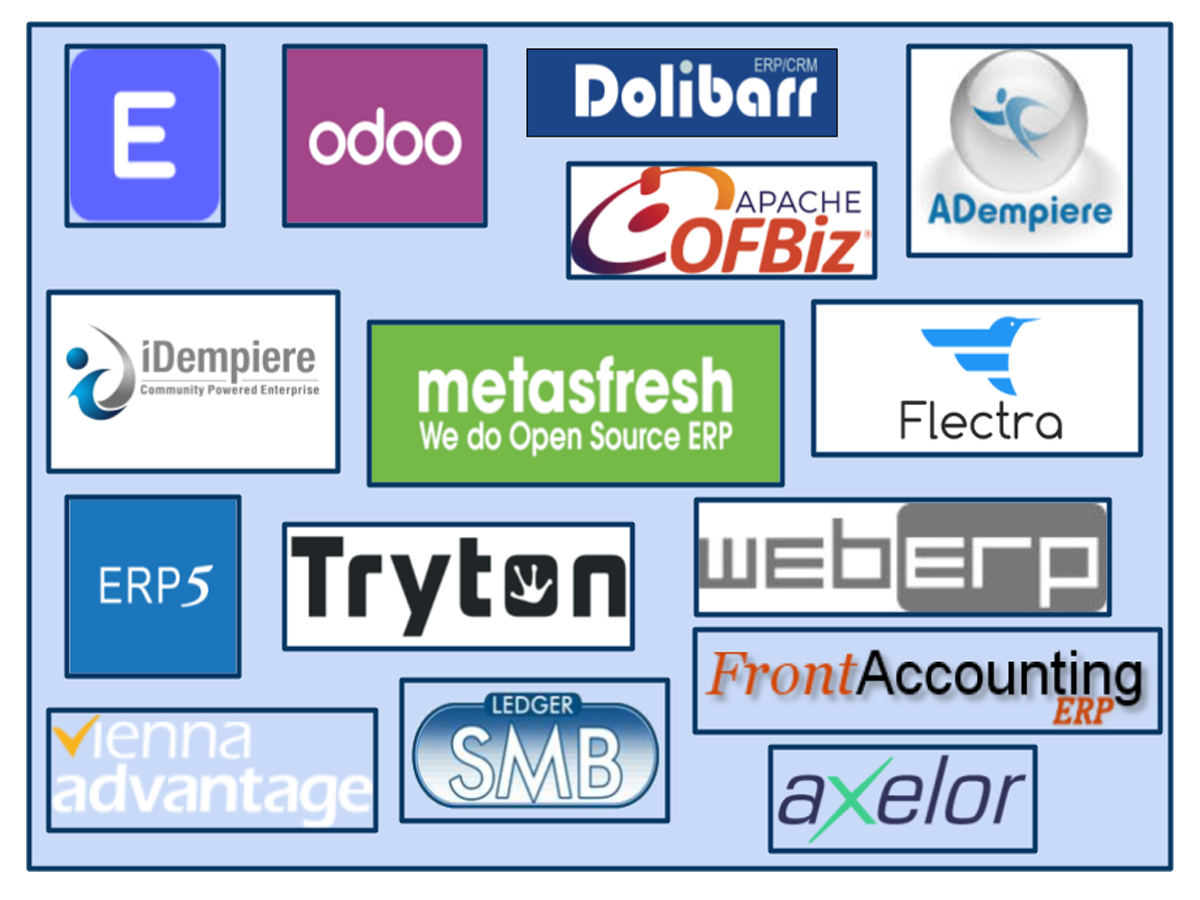
Unlocking Business Potential: A Comprehensive Guide to Open Source ERP Software
In the dynamic landscape of modern business, efficiency, integration, and data-driven decision-making are paramount. Enterprise Resource Planning (ERP) systems have emerged as the backbone for achieving these goals, unifying disparate business processes into a single, cohesive platform. While proprietary ERP solutions have traditionally dominated the market, a powerful and increasingly popular alternative has gained significant traction: open source ERP software.
Open source ERP offers businesses a unique blend of flexibility, cost-effectiveness, and community-driven innovation. Unlike their proprietary counterparts, open source systems provide access to their source code, allowing users to inspect, modify, and distribute the software freely. This article delves into the world of open source ERP, exploring its benefits, challenges, key features, and presenting a detailed list of leading options to help businesses make informed decisions.
What is ERP and Why Open Source?
At its core, an ERP system integrates all facets of an operation, including product planning, development, manufacturing, sales, marketing, and human resources. It streamlines workflows, automates tasks, and provides a centralized database for real-time information, ultimately enhancing productivity and strategic agility.
The “open source” aspect introduces several compelling advantages:
- Cost-Effectiveness: The most immediate appeal is the absence of license fees. While implementation, customization, and support costs still apply, the initial investment is significantly lower compared to proprietary systems.
- Flexibility and Customization: Access to the source code means businesses can tailor the ERP system precisely to their unique needs without vendor restrictions. This level of customization is often expensive or impossible with proprietary solutions.
- Transparency and Security: The open nature of the code allows for thorough security audits by the community, often leading to quicker identification and patching of vulnerabilities. It also eliminates “black box” concerns, fostering trust.
- Vendor Lock-in Avoidance: Businesses are not tied to a single vendor for updates, support, or further development. If a vendor ceases operations or fails to meet expectations, the community or another service provider can step in.
- Community Support and Innovation: A vibrant community of developers and users contributes to the software’s continuous improvement, bug fixes, and feature enhancements. This collective intelligence often drives faster innovation.
- Scalability: Many open source ERP solutions are built with scalability in mind, capable of growing with a business from a small startup to a large enterprise.
Challenges and Considerations
While the benefits are substantial, open source ERP is not without its challenges:
- Implementation Complexity: Setting up and configuring an ERP system, regardless of its origin, is a complex undertaking. Open source solutions often require a higher degree of technical expertise for successful implementation and customization.
- Support Model: While community support is a strength, it can be less predictable than dedicated vendor support. Businesses might need to invest in commercial support contracts from third-party providers or hire in-house experts.
- Feature Gaps: Depending on the specific software and business requirements, some niche features might be less mature or entirely absent compared to highly specialized proprietary systems. This often necessitates custom development.
- Total Cost of Ownership (TCO): While license fees are absent, TCO includes hardware, hosting, implementation, customization, training, maintenance, and support. It’s crucial to factor these into the budget.
- Training: User training is essential for successful adoption. The availability of structured training materials might vary across different open source projects.
Key Features to Look for in an ERP System
Before diving into specific software, it’s crucial to understand the common modules and functionalities expected in a robust ERP system:
- Financial Management: General ledger, accounts payable/receivable, budgeting, fixed assets, bank reconciliation, financial reporting.
- Supply Chain Management (SCM): Procurement, inventory management, warehousing, order management, logistics.
- Customer Relationship Management (CRM): Sales force automation, marketing automation, customer service, lead management.
- Manufacturing: Bill of materials (BOM), production planning, shop floor control, quality control.
- Human Resources Management (HRM): Payroll, employee records, recruitment, performance management, time and attendance.
- Project Management: Task management, resource allocation, time tracking, project costing.
- Business Intelligence (BI) & Reporting: Dashboards, analytics, customizable reports for data-driven insights.
- Sales & Distribution: Sales order processing, pricing, shipping, invoicing.
The Leading Open Source ERP Software List
Here’s a detailed look at some of the most prominent and actively developed open source ERP solutions available today:
1. Odoo
Description: Odoo (formerly OpenERP) is arguably the most popular and comprehensive open source ERP solution. It offers a vast suite of business management tools across various domains. Odoo operates on a modular architecture, with a core framework and thousands of “apps” (modules) that can be installed as needed. It comes in two main editions: Odoo Community (open source) and Odoo Enterprise (proprietary with additional features and services).
Key Features:
- Comprehensive Modules: CRM, Sales, Project Management, Manufacturing, Inventory, Accounting, HR, Website Builder, E-commerce, Marketing Automation, Point of Sale (POS), and many more.
- Modular Design: Users can start with a few modules and add more as their business grows.
- User-Friendly Interface: Modern and intuitive design, making it relatively easy to navigate.
- Extensive App Store: A marketplace for third-party modules and customizations.
- Scalability: Suitable for businesses from small startups to large enterprises.
Target Audience: SMEs and large enterprises across diverse industries (retail, manufacturing, services, e-commerce).
Pros:
- Vast feature set covering almost every business need.
- Large and active community.
- Strong ecosystem of partners and developers.
- Highly customizable.
- Regular updates and new features.
Cons:
- The most advanced features are often reserved for the Enterprise edition.
- Can be complex to set up and customize without expert help.
- Hosting and maintenance can incur significant costs.
2. ERPNext
Description: ERPNext is another highly regarded open source ERP, known for its modern user interface and holistic approach to business management. Built on the Frappe Framework (a full-stack web framework also open source), ERPNext emphasizes ease of use and a clean design while providing powerful functionalities.
Key Features:
- Integrated Modules: Financial Accounting, CRM, Sales, Purchasing, Inventory, Manufacturing, Project Management, HR & Payroll, Asset Management, Website, E-commerce, and more.
- User-Friendly UI: Designed for simplicity and intuitive navigation.
- Industry-Specific Features: Includes features tailored for manufacturing, retail, services, education, and agriculture.
- Robust Reporting: Customizable dashboards and reporting tools.
- Multi-Company, Multi-Currency, Multi-Lingual Support.
Target Audience: Small to medium-sized businesses (SMBs) and some larger enterprises looking for an all-in-one solution with a focus on usability.
Pros:
- Excellent user experience (UX).
- Comprehensive feature set out-of-the-box.
- Strong and supportive community.
- Relatively easy to get started with compared to some other complex ERPs.
- Frappe Cloud offers convenient hosting options.
Cons:
- Customization can sometimes be more challenging than Odoo due to its framework structure, though Frappe’s doctype system offers flexibility.
- Community support is strong, but dedicated commercial support might be needed for critical issues.
3. Dolibarr ERP CRM
Description: Dolibarr is a relatively lightweight and easy-to-use open source ERP and CRM solution primarily aimed at small to medium-sized businesses, freelancers, and associations. It focuses on simplicity and efficiency, offering essential functionalities without overwhelming complexity.
Key Features:
- Core Modules: Product/Service catalog, Sales (quotes, orders, invoices), Purchasing, Inventory, HR (employees, leave), Project Management, Point of Sale (POS), Document Management, Bank Management.
- Modularity: Users can enable or disable modules as needed.
- User-Friendly Interface: Clean, straightforward, and easy to learn.
- Easy Installation: Known for its relatively simple installation process.
- Third-Party Add-ons: A marketplace for additional modules and integrations.
Target Audience: Small businesses, freelancers, consultants, and associations looking for an essential, no-frills ERP/CRM solution.
Pros:
- Very easy to install and use.
- Low learning curve.
- Suitable for businesses with simpler requirements.
- Active community and regular updates.
- Good balance of features for its target market.
Cons:
- May lack advanced features required by larger or more complex organizations.
- Customization options might be less extensive than Odoo or ERPNext.
- Reporting capabilities might be basic for advanced analytics needs.
4. Tryton
Description: Tryton is a high-level, modular, and scalable open source ERP solution written in Python and based on a three-tier architecture. It distinguishes itself by its strong focus on technical robustness, data integrity, and a flexible framework that allows developers to build highly customized solutions.
Key Features:
- Modular Architecture: Financial Accounting, Sales, Purchasing, Inventory, Project Management, Manufacturing, HRM, and more.
- Robust Design: Emphasizes data consistency and reliability.
- Client-Server Model: Offers both a desktop client and a web client.
- Highly Flexible: Designed for extensive customization and integration.
- Strong ORM: Utilizes a powerful Object Relational Mapper for database interaction.
Target Audience: Businesses with specific or complex requirements, particularly those with in-house Python development expertise or access to specialized consultants. Suitable for SMBs to larger enterprises.
Pros:
- Exceptional flexibility and customization capabilities for developers.
- Strong focus on data integrity and robustness.
- Scalable and reliable.
- Active and technically proficient community.
Cons:
- Steeper learning curve for non-technical users.
- Requires more technical expertise for implementation and maintenance.
- The out-of-the-box user interface might feel less modern than Odoo or ERPNext for some.
5. Metasfresh
Description: Metasfresh is a fast, responsive, and modern open source ERP solution that originated as a fork of ADempiere (another open source ERP). It focuses on providing a modern user experience and robust functionality, particularly for manufacturing, trading, and supply chain management.
Key Features:
- Modern UI/UX: Designed for speed and ease of use, with a responsive interface.
- Comprehensive Modules: Sales, Purchasing, Manufacturing, Inventory, Financial Accounting, CRM, Project Management.
- Real-time Dashboards: Provides immediate insights into business operations.
- Strong for Supply Chain: Excellent capabilities for procurement, logistics, and warehouse management.
- Tech Stack: Built on Java, PostgreSQL, and Elasticsearch.
Target Audience: Mid-sized to large enterprises, especially those in manufacturing, wholesale, and distribution, seeking a modern and performant ERP.
Pros:
- Modern, fast, and responsive user interface.
- Strong capabilities for manufacturing and supply chain.
- Actively developed with regular updates.
- Good performance and scalability.
Cons:
- Community might be smaller compared to Odoo or ERPNext.
- Can be resource-intensive to host and maintain.
- Requires Java expertise for deep customization.
6. iDempiere
Description: iDempiere is an open source ERP, CRM, and SCM solution that continues the legacy of Compiere and ADempiere. It is a powerful, enterprise-grade system built on Java, known for its robust features and flexibility, particularly for businesses with complex processes.
Key Features:
- Enterprise-Grade Modules: Financials, Supply Chain Management, Manufacturing, CRM, Point of Sale, Project Management, HR, and more.
- “Active Business Process Management”: A key differentiator, allowing users to define and automate business processes within the system.
- Multi-tenant, Multi-currency, Multi-language: Designed for international and complex organizational structures.
- Reporting and Business Intelligence: Extensive reporting capabilities.
Target Audience: Medium to large enterprises, especially those with complex supply chains, manufacturing operations, or a need for detailed process automation.
Pros:
- Extremely robust and feature-rich.
- Highly flexible and customizable.
- Strong emphasis on business process management.
- Mature and stable, with a dedicated community.
Cons:
- Steep learning curve for both users and administrators.
- The user interface can feel dated compared to newer solutions.
- Requires significant technical expertise (Java) for implementation and maintenance.
7. Apache OFBiz
Description: Apache OFBiz is an open source enterprise automation software project that provides a suite of business applications built on a common framework. It’s less of an out-of-the-box ERP and more of a flexible framework for building customized enterprise solutions.
Key Features:
- Comprehensive Business Suite: Includes modules for E-commerce, CRM, Warehouse Management, Manufacturing, Accounting, Project Management, and more.
- Framework-First Approach: Highly customizable at the code level, allowing businesses to build exactly what they need.
- Integrated Data Model: All modules share a common data model, ensuring data consistency.
- Scalable Architecture: Designed for enterprise-level deployment.
Target Audience: Large enterprises or businesses with very specific, complex requirements and significant in-house development resources or access to specialized consultants.
Pros:
- Ultimate flexibility and customization potential.
- Robust and scalable framework.
- Backed by the Apache Software Foundation, ensuring stability and longevity.
Cons:
- Not an out-of-the-box solution; requires substantial development effort for implementation.
- Steepest learning curve among the listed options.
- The UI can be less intuitive and modern.
- Requires deep Java and XML expertise.
Choosing the Right Open Source ERP for Your Business
Selecting the ideal open source ERP is a critical strategic decision that demands careful consideration:
- Assess Your Business Needs: Clearly define your current pain points, required functionalities, industry-specific needs, and future growth plans. Prioritize “must-have” features versus “nice-to-have.”
- Evaluate Features and Modules: Compare the core modules of each ERP system against your requirements. Look for comprehensive financial management, inventory control, sales, and reporting capabilities.
- Consider Total Cost of Ownership (TCO): Factor in not just license fees (which are often zero), but also implementation, customization, hosting, maintenance, training, and potential commercial support costs.
- Community and Support Ecosystem: A vibrant community indicates ongoing development, readily available help, and a healthy ecosystem. Evaluate the availability of commercial support partners if community support isn’t sufficient.
- Scalability and Performance: Ensure the chosen solution can handle your current data volume and transactions, and has the capacity to scale as your business grows.
- Technical Expertise: Assess your internal IT capabilities or budget for external consultants. Some open source ERPs require more technical prowess than others.
- User Experience (UX): A user-friendly interface is crucial for adoption and minimizing training costs. Consider how intuitive the system is for your employees.
- Trial and Demo: Whenever possible, test-drive the software. Most open source ERPs offer demo instances or easy local installation for evaluation.
Conclusion
Open source ERP solutions represent a powerful paradigm shift, offering businesses unprecedented control, flexibility, and cost savings compared to traditional proprietary systems. From the comprehensive modularity of Odoo and the user-friendliness of ERPNext to the robust technical foundations of Tryton and iDempiere, and the customizable framework of Apache OFBiz, there’s a solution tailored for nearly every business size and industry.
While the journey to implement an open source ERP might require a greater upfront investment in planning and technical expertise, the long-term benefits – freedom from vendor lock-in, unparalleled customization, and a supportive global community – can unlock immense business potential, fostering innovation and sustainable growth in an increasingly competitive world. By carefully evaluating their specific needs and considering the options presented, businesses can harness the power of open source to build an ERP system that truly aligns with their strategic objectives.
Leave a Reply